Cultural Etiquette Travel Guide: How to Respect Local Customs Around the World

Picture this: you’re sitting in a traditional Japanese restaurant, chopsticks in hand, ready to dig into a steaming bowl of ramen. Without thinking, you stick your chopsticks upright in the rice—and suddenly notice the shocked faces around you. What you didn’t know is that you’ve just mimicked a funeral ritual. Awkward, right? Understanding cultural etiquette travel basics isn’t about memorizing endless rules—it’s about showing respect, avoiding unintentional offense, and unlocking richer, more authentic travel experiences that go beyond the tourist surface.
Why Cultural Etiquette Matters When Traveling
When you step off the plane in a foreign country, you’re not just changing locations—you’re entering a completely different social landscape with its own unwritten rules. Cultural etiquette travel awareness is what separates memorable, meaningful experiences from embarrassing misunderstandings that can damage relationships before they even begin.
Respecting local customs does more than just keep you out of trouble. It opens doors that would otherwise remain closed. Locals can immediately sense when someone has made an effort to understand their culture, and they respond with warmth, patience, and generosity. A simple gesture—removing your shoes before entering a home in Thailand, greeting elders first in Ghana, or using both hands when exchanging business cards in South Korea—signals that you see them as people, not just exotic backdrops for your vacation photos.
Beyond personal connections, cultural respect contributes to sustainable travel practices that preserve traditions and communities. When travelers demonstrate cultural sensitivity, they help combat the erosion of local customs caused by mass tourism. Small acts of respect ripple outward, influencing how entire communities view and interact with visitors.
Essential Cultural Etiquette Rules by Region
Different countries and regions have vastly different social norms, and what’s perfectly acceptable in one place might be deeply offensive elsewhere. Let’s break down the most important cultural etiquette travel considerations by major world regions.
Asia operates heavily on concepts of hierarchy, harmony, and ‘face’—the social reputation that must be preserved at all costs. In countries like Japan, China, and Korea, direct confrontation is avoided, and causing someone to lose face publicly is one of the worst social offenses. Bowing depth indicates respect levels, and removing shoes indoors is non-negotiable in most settings. Hand gestures matter enormously: pointing with one finger is rude (use your whole hand instead), and touching someone’s head—considered sacred in Thailand—is absolutely forbidden. When visiting places like cultural heritage sites, modesty and quiet observation are expected.
Europe presents a patchwork of customs, but some patterns emerge. Northern Europeans value punctuality almost religiously—being late in Germany or Switzerland is considered disrespectful. Southern Europeans take a more relaxed approach to time but are formal in initial interactions. In France and Italy, greeting shopkeepers when entering and leaving stores is basic courtesy. Table manners are taken seriously across the continent: keep hands visible (but not elbows on the table), and don’t start eating until everyone is served.
Middle Eastern cultures emphasize hospitality to an extraordinary degree, but with specific parameters. Modest dress is essential, especially for women—covering shoulders, knees, and sometimes hair in conservative areas. The left hand is considered unclean in many countries, so always eat, give, and receive with your right hand. Gender interactions follow stricter rules than in Western countries; men should wait for women to extend their hand for a handshake rather than initiating. When offered tea or coffee, refusing immediately can be seen as rude—the ritual often requires polite back-and-forth before acceptance.
Africa is incredibly diverse, but respect for elders is nearly universal. Greetings are lengthy and important—rushing through them suggests the person isn’t worth your time. In many African cultures, asking permission before photographing people or their property is essential, and sometimes a small fee is expected. When navigating markets like the Marrakech souks, understanding local bargaining etiquette becomes part of respectful interaction.
The Americas show significant variation between regions. North Americans generally value personal space and direct communication, while Latin American cultures are often more comfortable with physical proximity and indirect communication to preserve harmony. Tipping culture varies dramatically—expected and substantial in the United States and Canada, but less common or even insulting in some South American countries. In places like Cuba, understanding local customs around currency and social interaction becomes crucial for respectful travel.

Dining and Food Etiquette Across Cultures
Food is where culture becomes tangible, and dining etiquette varies wildly across the globe. In Japan, slurping noodles shows appreciation, but passing food chopstick-to-chopstick mimics funeral rites and should never be done. Finishing every grain of rice shows gratitude, while leaving food can suggest it wasn’t good enough. In India and much of the Middle East, eating with your right hand is traditional and expected in many settings—but only specific fingers, and there’s a technique to master.
France maintains strict table manners: bread goes on the table (not on your plate), and you should tear it with your hands rather than biting directly. Wine glasses are filled by your neighbor, not yourself. In Ethiopia, communal eating from a shared platter is the norm, and being fed by someone else (gursha) is a sign of respect and friendship. China presents its own complexities: leaving a small amount of food shows you were well-fed, while cleaning your plate suggests you weren’t given enough.
Refusing food can be tricky. In many cultures, outright refusal is rude—instead, try small portions with praise. Understanding alcohol customs matters too: in Russia and Poland, toasting is ritualized with eye contact required; in Muslim countries, alcohol may be completely forbidden or restricted.
Dress Codes and Physical Gestures to Know
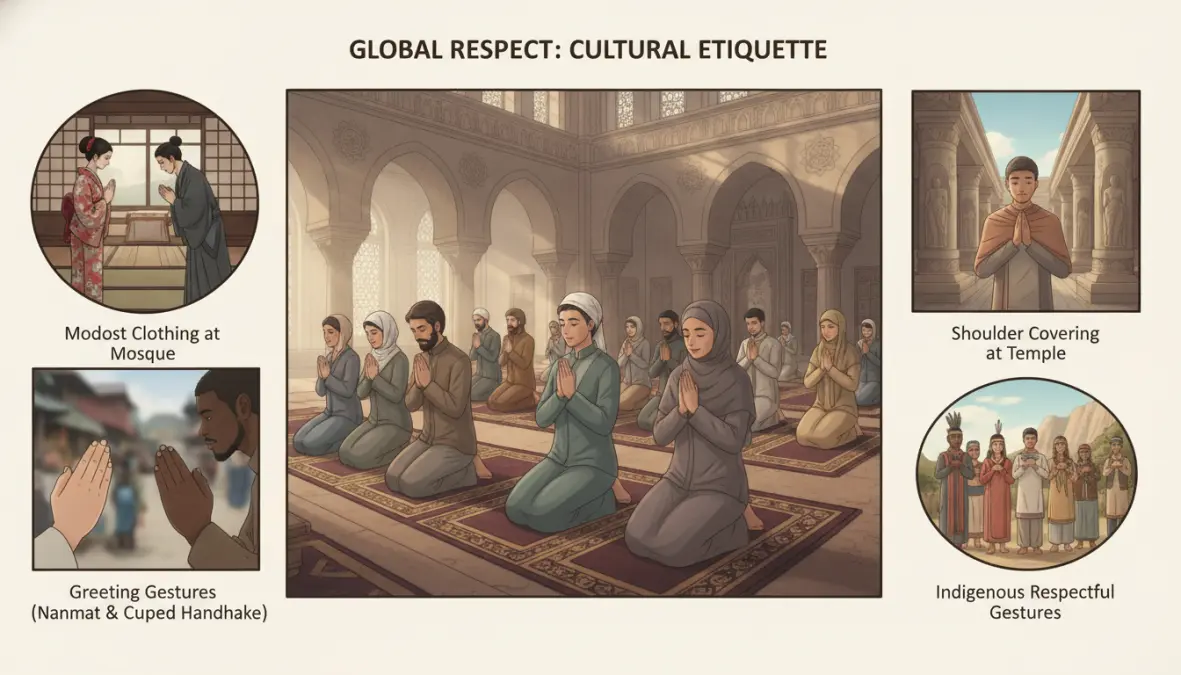
What you wear and how you move communicates volumes before you say a word. Religious sites worldwide require modest dress—covered shoulders and knees at minimum, with many requiring head coverings or removed shoes. When exploring regions like Transylvania’s medieval churches, respectful attire shows cultural sensitivity.
Common gestures have dramatically different meanings. The ‘thumbs up’ that signals approval in Western countries is obscene in parts of the Middle East and Greece. The ‘OK’ sign (thumb and forefinger circle) is offensive in Brazil and Turkey. Nodding means ‘no’ in Bulgaria and parts of Greece, while head wobbling in India can mean anything from ‘yes’ to ‘maybe’ to ‘I’m listening’—context is everything.
Physical contact norms vary enormously. Mediterranean and Latin American cultures embrace cheek kissing (one, two, or three kisses depending on location), while many Asian cultures avoid physical contact beyond handshakes. Middle Eastern men may walk hand-in-hand as a sign of friendship, while public affection between romantic partners is frowned upon. Personal space bubbles expand in Northern Europe and North America but shrink dramatically in crowded Asian and South American cities.
Practical Tips for Culturally Respectful Travel
Mastering cultural etiquette travel doesn’t require encyclopedic knowledge—just the right approach. Start with research before departure: read recent travel blogs, watch cultural videos, and consult guidebooks that go beyond tourist attractions. Learning even basic phrases in the local language—’hello,’ ‘thank you,’ ‘excuse me,’ ‘please’—demonstrates respect and opens hearts immediately.
Once you arrive, become an observer before a participant. Watch how locals interact before jumping in. Notice how they greet each other, how they eat, how they dress. When in doubt, ask. Most people appreciate genuine curiosity over ignorant assumption. Phrases like ‘What’s the proper way to…?’ or ‘Would it be okay if…?’ show humility and willingness to learn.
Photography deserves special attention. Always ask permission before photographing people, religious ceremonies, or private spaces. In some cultures, photographs are believed to capture the soul; in others, they’re simply invasive. Some locations prohibit photography entirely for religious or security reasons. A gesture or smile can ask permission across language barriers.
Consider bringing small, appropriate gifts from your home country when visiting people’s homes—but research what’s appropriate first. Yellow flowers mean death in Mexico, clocks are unlucky in China, and alcohol is inappropriate in Muslim households. Before your trip, make sure you have comprehensive travel insurance coverage that protects you in various cultural contexts. Practical preparation with proper organization systems and communication tools helps you navigate cultural situations more confidently.
Respect religious practices and local festivities. During Ramadan, avoid eating or drinking publicly in Muslim countries during daylight hours. Remove shoes and cover up in temples and mosques. Stand when national anthems play. These small acts of respect cost nothing but earn enormous goodwill.
FAQ: Common Cultural Etiquette Questions
What should I do if I accidentally offend someone?
Apologize immediately and sincerely. A simple ‘I’m sorry, I didn’t know’ in their language (or English with apologetic gestures) usually repairs the damage. Most locals forgive cultural mistakes when they see genuine remorse and effort to learn.
How do I politely decline food or gifts?
Rarely refuse outright. Instead, accept with gratitude, take a small portion, and explain (dietary restrictions, fullness, etc.). In many cultures, refusing once is expected etiquette—wait for the second or third offer, then accept graciously.
Is tipping expected everywhere?
No. Tipping is standard in North America (15-20%), optional in Europe (rounding up or 5-10%), and can be insulting in Japan. Research specific countries beforehand, as expectations vary dramatically even between neighboring nations.
How do I know if photography is appropriate?
Look for signs prohibiting photos. In their absence, observe locals—if they’re not photographing, you probably shouldn’t either. For people, always ask permission through gesture or words. When in doubt, don’t shoot.
What are universal signs of respect across cultures?
Smiling (in most contexts), listening more than talking, dressing modestly in religious/formal settings, arriving on time (or fashionably late where expected), saying please and thank you, and showing patience all translate across cultural boundaries.
How formal should I be when meeting locals?
Start formal and let locals guide you to informality. Use titles and surnames until invited to use first names. Observe how locals dress for similar situations and match their level. Err on the side of respect—you can always become more casual, but you can’t undo a bad first impression.
Cultural etiquette travel transforms you from a tourist into a respectful global citizen. Every effort you make to understand and honor local customs enriches your journey immeasurably, creating connections that transcend language and geography. The world opens differently when you approach it with humility, curiosity, and respect—and that’s when travel becomes truly transformative.